
Abatement Technologies Air Duct Cleaning in Lake Stevens: A Homeowner’s Guide
There’s a real difference between cleaning a duct system and remediating one. Abatement Technologies builds equipment for the second scenario – the kind of work done after mold, smoke infiltration, or heavy construction dust. Knowing which situation your Lake Stevens home is actually in changes the entire service decision. Most homeowners assume a standard vacuuming is all that’s ever needed. Sometimes that’s true. Sometimes it isn’t, and the gap between the two is where money gets wasted and problems linger. If you’d rather not sort through it alone, call (855) 726-7819 and we’ll talk it through.
What makes Abatement Technologies equipment different from a standard vacuum?
A standard portable duct vacuum moves air and captures the larger debris. An Abatement Technologies HEPA negative air machine is built to a different spec: it filters at the 0.3-micron level, which is the particle size where HEPA certification is measured, and it holds containment under sustained negative pressure so dislodged contaminants don’t drift back into living space. That second part is what separates remediation-grade equipment from a shop vac with a long hose.
Here’s the practical difference during a service call in Lake Stevens:
- Containment capacity. Negative air machines pull the work area into slight vacuum so loosened material travels toward the filter, not toward your hallway.
- Particle capture. HEPA filtration at 0.3 microns catches mold spores, fine drywall dust, and combustion residue that a standard filter passes through.
- Sustained operation. These units are rated to run through a full remediation job, not a fifteen-minute pass over a few registers.
- Filter loading. Remediation-grade machines use staged filtration (pre-filter, secondary, HEPA) so the final filter isn’t overwhelmed by bulk debris.
We run Rotobrush rotary brush systems to physically dislodge what’s stuck to duct walls, and Nikro negative-air equipment for containment. Abatement Technologies is the third leg – the filtration class that matters when the contamination itself is the problem, not just its volume.
When is remediation-grade equipment actually warranted in Lake Stevens?
Not every job needs it. That’s the honest answer, and it’s the one most companies won’t give you because the equipment is expensive and mentioning it sells upgrades. In our experience, four scenarios push a Lake Stevens home past standard cleaning and into remediation territory:
- Post-mold remediation clearance. If a crawlspace or air handler has already been treated for mold, the ducts need cleaning with containment equipment or the spores you just paid to remove get redistributed through the supply registers.
- Wildfire smoke infiltration. Smoke residue is fine particulate that settles into duct lining and insulation. Standard suction stirs it; HEPA negative air captures it.
- Post-construction fine particulate. Drywall dust, silica, and joint compound particles are exactly the size range HEPA equipment is built for.
- Long-deferred systems with visible contamination at the registers. When debris is visible at the supply vents, the interior of the system is carrying more than a routine job handles.
If none of those apply and your system has been serviced reasonably, standard air duct cleaning is the right call and we’ll tell you so.
Why Lake Stevens homes hit the remediation threshold more often than expected
Two features of housing stock around Lake Stevens raise the odds. First, crawlspace HVAC systems are common here, and a system with ductwork running through a crawlspace is exposed to ground moisture, pest activity, and temperature swings that a conditioned-chase system never sees. That environment is where mold and biological growth get a foothold.
Second, a lot of homes in the area were built with older flex ductwork. Flex duct has a corrugated interior that traps debris in the ridges, and it degrades over time – tears, sagging runs, disconnected joints. Once a flex run is compromised, unfiltered air from a crawlspace or attic gets pulled into the supply path. That’s not a cleaning problem. That’s a system integrity problem, and cleaning alone won’t fix it.
Add the region’s wet winters and the shoulder seasons when a house sits closed up with the HVAC cycling, and you get conditions where moisture and particulate accumulate quietly for years. Homeowners notice a musty smell or worsening allergies and assume it’s the filter. Often it’s the duct system behind it.
What a technician should be doing differently on a remediation-grade call
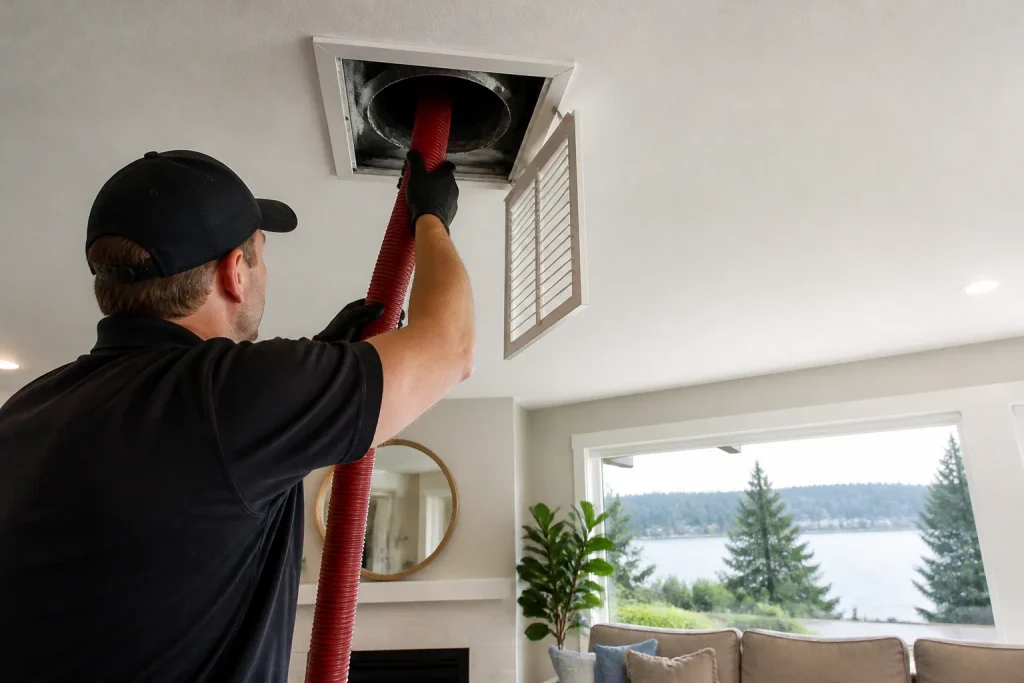
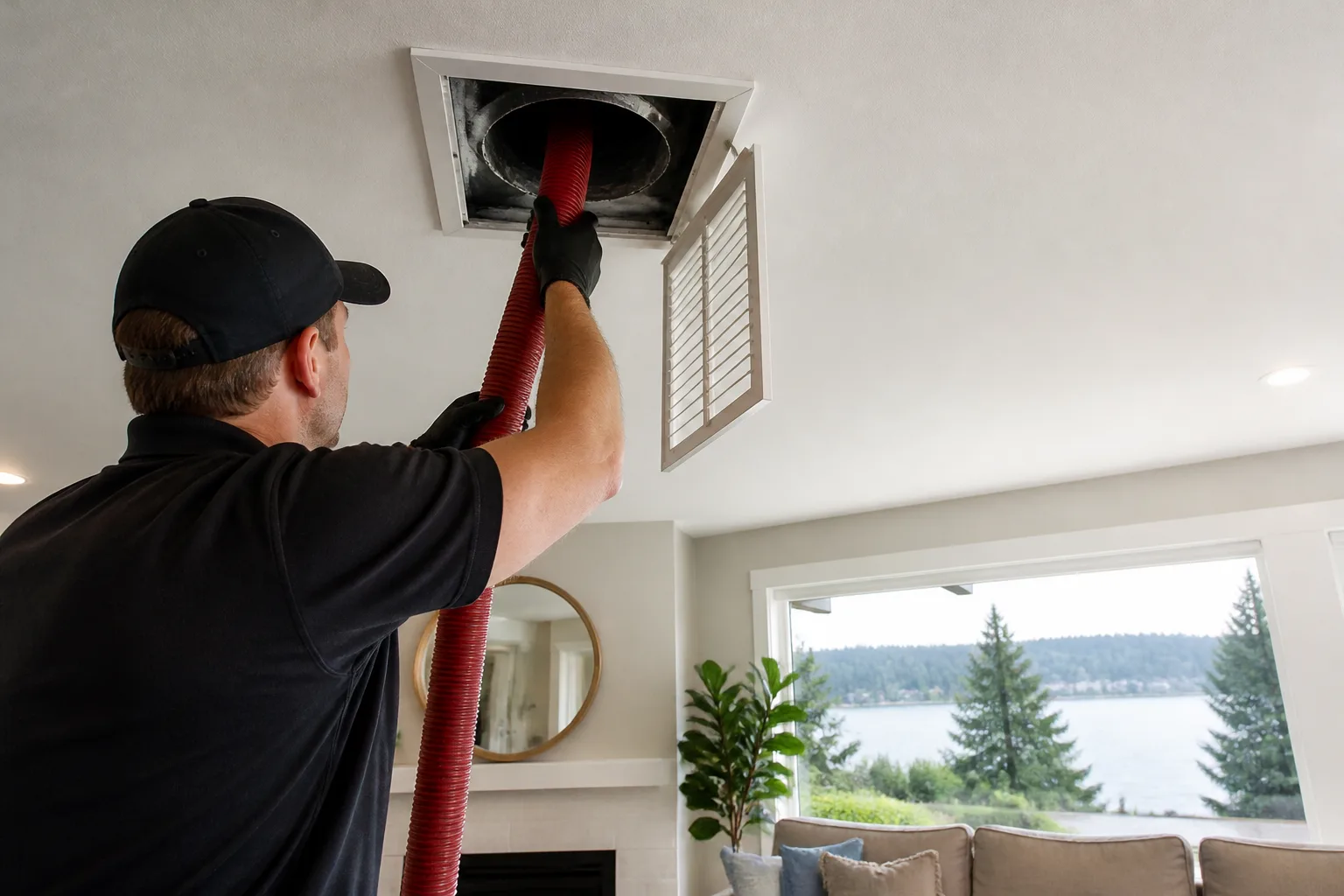
Equipment on the truck means nothing if it isn’t operated correctly. When Abatement Technologies equipment is genuinely deployed on a Lake Stevens job, you should see and hear a different process than a standard cleaning:
- Containment set up before cleaning starts. Negative air established at the start, not halfway through.
- Source control at the air handler and registers. Openings sealed so the system is under control while work happens.
- Agitation with rotary brush or air whips, then capture. Debris gets loosened from surfaces first, then pulled into HEPA filtration – not vacuumed in place and hoped for.
- Sanitizing as a separate step. Removing debris and addressing biological contaminants are two different jobs. We treat them that way.
- System inspection after cleaning. Seams, joints, and flex runs checked for the leaks that caused the problem in the first place.
That last point is where Lake Stevens Air Duct Cleaning differs from a lot of what’s out there. Cleaning a contaminated system without sealing the leaks that let contamination in means you’ll be doing it again. That’s why we also handle HVAC cleaning and duct repair and sealing – the full air pathway, not just the parts you can see.
How do you verify remediation-grade equipment was actually used?
Ask before the job, and ask for documentation after. A company that runs this equipment can tell you what class of machine it uses, what filtration rating, and how containment was set up. Vague answers are a signal. So is equipment that’s visibly sitting in a van unused.
What to request:
- Before-and-after photos of your own duct interior, not stock images
- The equipment model or class used on the job
- Filter staging described (pre-filter, secondary, HEPA)
- A written scope that states whether sanitizing was included
One flat price per system, agreed before work starts, is the other thing to insist on. Per-vent pricing and teaser coupons are how the bait-and-switch works – a low number at booking, a much larger invoice once the technician is standing in your hallway. Ask for the whole-system number in writing up front.
When to call a pro
Call us if you’re seeing visible debris at the registers, smelling something musty when the system kicks on, dealing with a crawlspace system that’s never been professionally serviced, or coming off mold remediation or a construction project. Those are the situations where standard cleaning isn’t the right tool. For routine upkeep, or if you need dryer vent cleaning handled at the same time, we’ll tell you what the job actually needs.
Related services in Lake Stevens: air duct cleaning, HVAC cleaning, dryer vent cleaning, and duct repair and sealing.
The Bottom Line
Abatement Technologies equipment matters when contamination is significant – mold, smoke residue, construction particulate – not as an upsell on every job. Lake Stevens homes with crawlspace systems and aging flex duct hit that threshold more often than owners expect, and the fix is usually a combination of remediation-grade cleaning plus sealing the leaks that let the problem in. Ask what equipment will be used, ask for photos of your own ducts, and get one flat price per system before anyone starts. Our technicians have up to 10 years of experience, and we carry Honeywell and Aprilaire air quality products for the long-term side of the work. If you’re in Lake Stevens and need help, Lake Stevens Air Duct Cleaning offers free estimates – call (855) 726-7819. We answer 24/7. Fast dispatch from 7am to 7pm, Sunday through Friday.
Frequently Asked Questions
No. It’s necessary when contamination is significant – post-mold remediation, wildfire smoke, heavy construction dust, or a long-neglected crawlspace system. For routine cleaning on a reasonably maintained system, standard professional equipment does the job. We’ll tell you which category your home falls into rather than defaulting to the more expensive option.
Remediation-grade work costs more than routine cleaning because of containment setup, longer run times, and sanitizing. We quote one flat price per system after seeing the job, in writing, before any work begins – no per-vent pricing, no coupon price that turns into a bigger invoice on site. Call (855) 726-7819 for an exact quote; estimates are free.
You’ll hear negative air machines running and see containment in place before cleaning starts. Ask for before-and-after photos of your own duct interior and a written scope describing the sanitizing step. A company running real remediation equipment can explain its filtration staging and containment method without hesitation.
Not automatically. Compromised flex duct in a damp crawlspace raises the likelihood that contamination has entered the system, but the only way to know is inspection. If the runs are torn or disconnected, cleaning alone won’t solve it – sealing and repair have to come first or the system keeps pulling unfiltered air. Call (855) 726-7819 and we’ll take a look.
Written by the team at Lake Stevens Air Duct Cleaning.
Need Air Duct Cleaning Help?
Call Lake Stevens Air Duct Cleaning - the local pro we connect you with is licensed and insured, with free written estimates in Lake Stevens.
(855) 726-7819